

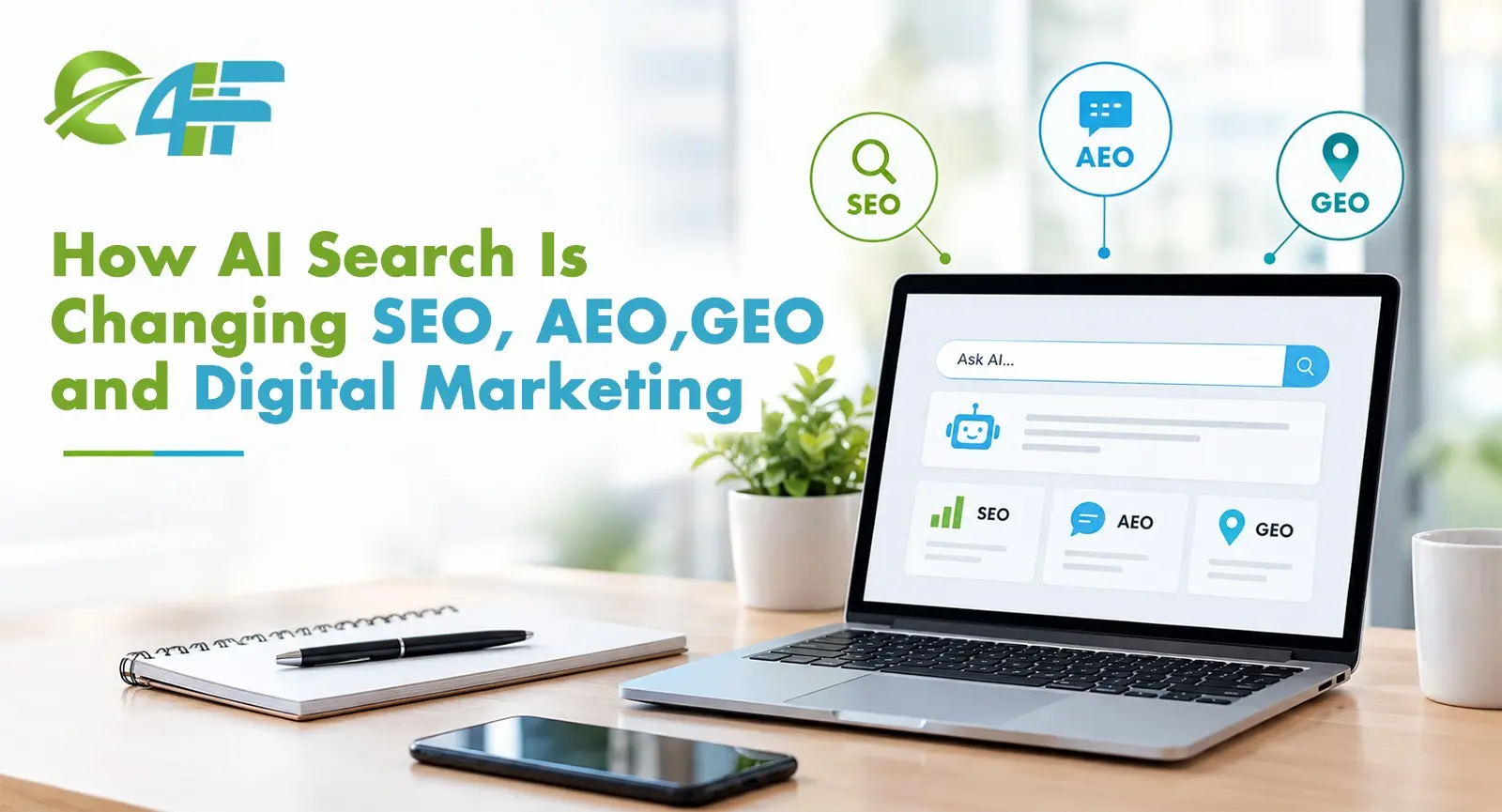
Quick Summary: AI search is affecting clicks, but it is not affecting the value of good content. This article covers what the data shows, how SEO, AEO, and GEO differ, how AI tools choose their sources, and what to change on your pages and in your reporting. It also lists the mistakes that waste effort.
Introduction
Ask a question in Google, and you may get a written answer before you see a single link. Ask ChatGPT, and you get an answer with a few sources linked beside it. Either way, the click that once rewarded a first-page ranking is no longer something you can count on. That is why AI search and SEO now have to be planned together. AI search engines such as Google AI Overviews, AI Mode, ChatGPT, and Perplexity read, combine, and summarize pages instead of simply listing them, which changes how people discover brands and how marketers measure success. This article explains what has changed, how SEO, AEO, and GEO differ, how AI-powered search chooses its sources, and what content optimization for AI search looks like in practice. You will also see what it means for your wider B2B digital marketing plan, the mistakes to avoid, and answers to the questions marketers ask most.
What AI Summaries Do to Search Traffic
For AI Search and SEO alike, the scale is hard to ignore. Google announced that AI Mode passed one billion monthly users, and OpenAI reported 900 million weekly ChatGPT users in early 2026. Behavior is shifting with them. Pew Research analyzed 68,000 searches and found that people clicked a traditional result on 8% of visits with an AI summary, against 15% without one. Only 1% clicked a link inside the summary.
Rankings feel the pressure too. Ahrefs data from December 2025 shows that Google AI Overviews lower the click-through rate of the top-ranking page by 58%. These stats are not all negative for AI Search and SEO, though. Seer Interactive found that brands cited inside an AI Overview earned roughly 35% more organic clicks than brands left out. Google disputes this by saying clicks from AI features are higher quality, so treat each study as one data point.
SEO vs. AEO vs. GEO: Key Differences
The acronyms overlap, but each points at a different surface:
- SEO: Earns a high ranking in the list of links, so people click through.
- AEO (Answer Engine Optimization): Structures content so a platform can lift a direct answer from it, as in snippets and AI Overviews.
- GEO (Generative Engine Optimization): Aims to get your brand cited or recommended inside answers from tools such as ChatGPT, Gemini, and Perplexity.
Some experts treat AEO and GEO as one discipline under two names. What matters is that AI search and SEO share the same foundation, so neither replaces the other.
How AI Search Engines Pick Their Sources
Google describes a technique called query fan-out, where AI Overviews and AI Mode run several related searches across subtopics before writing an answer. That means one page can be pulled in for a question the user never typed. AI Mode and AI Overviews may use different models, so the links they show can differ. Eligibility is simple: a page must be indexed and eligible to appear in Search with a snippet. For AI search and SEO, Google also says no special optimization is required beyond standard SEO fundamentals, such as helpful, people-first content and clear internal links. A page Google cannot index cannot appear in these features.
Making Your Pages Easy to Cite
Strong content optimization for AI search is mostly about clarity. Start with these moves:
- Answer first: Open each section with a direct two-sentence answer, then add detail.
- Show experience: Original data, named authors, and first-hand examples give AI-powered search something worth citing.
- Keep facts quotable and current: Cite figures with their source and date, and refresh them, since stale numbers weaken trust.
None of this needs tricks. Across AI Search and SEO, it needs pages that a reader, or a machine, can trust and quote quickly.
Rethinking Your Digital Marketing Scorecard
Traffic alone no longer tells the full story, so widen what you track:
- Brand visibility: Branded searches have held up better. Amsive reported an 18% higher click-through rate on branded queries with AI Overviews. Treat branded demand as an asset worth protecting.
- Citations and mentions: Note where AI search engines name your brand, and which competitors appear beside you.
- Lead quality: Fewer clicks can still carry stronger intent, so compare conversions, not only sessions.
- Search Console: Traffic from AI features is included in your overall Search Console totals, so watch AI Search and SEO trends page by page.
A team that tracks only rankings will miss most of this.
Common Mistakes To Avoid
Most visibility losses trace back to a few avoidable habits:
- Abandoning classic SEO: AI features draw on indexed pages, so weak fundamentals sink both.
- Chasing acronyms: Treating AEO or GEO as a separate project before fixing content gaps wastes budget.
- Writing for machines only: Stuffed, robotic pages earn neither citations nor trust.
- Ignoring measurement: Without a baseline, you cannot tell whether a change helped.
Avoiding these keeps your AI Search and SEO effort pointed at what works.
Conclusion
AI search has not ended SEO. It has raised the standard for it. Pages that load, answer clearly, and carry trustworthy facts still earn visibility, now through rankings, citations, and brand mentions together. Review your most important pages with that lens in mind, measure where your brand already appears, and improve one section at a time. If you want a second pair of eyes on that process, Eye4Future can help you plan your next steps in AI Search and SEO.
FAQs
What is AI search optimization?
Is SEO dead because of AI search?
How long does AI search optimization take to work?
How do I know if AI tools mention my brand?
Does AI search change how B2B buyers research vendors?

Eye4Future
Since 2014, Eye4Future has been delivering innovative digital marketing and web development solutions to help businesses grow online. Our expert team creates tailored strategies that drive success and boost visibility.



 Company Profile
 Why Choose Us
 Clients Testimonial
 Mission, Vision & Goals
 Frequently Asked Questions
 Designing
 Development
 E-commerce
 Digital Marketing
 Reputation Management